
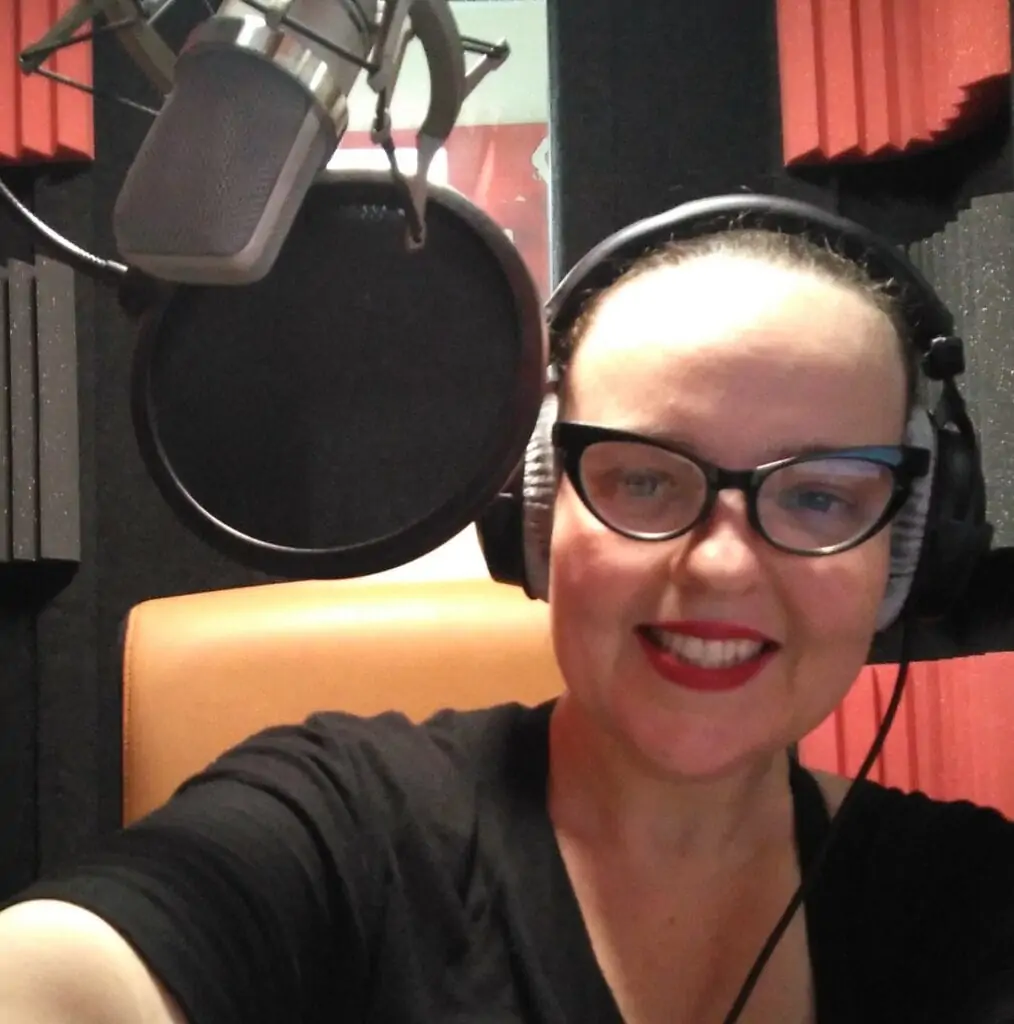
Here is Source Elements Podcast On the Mic remote recorded with Source-Connect. Today we have Susie Valerio, a female Brazilian Voice Over Artist based in the UK. Susie was born in Brazil and raised bilingual. She records daily in unplaceable International English and Native Brazilian Portuguese.
Susie graduated in Drama, Film & TV from Brunel University and later completed a two-year Meisner Technique programme with The Impulse Company, in London. That was followed by a Masters Degree in Documentary Making and by many years working in Production for Film, TV and Advertising.
As a result of this combination, Susie has very solid background on both sides of the mic – a wealth of professional experience, gained across most areas of the entertainment business over the past 25 years. Susie’s warm, husky, friendly and natural tones can be heard in pieces across most genres, with her soft hybrid accent adding a unique cosmopolitan flavour to some of the coolest brands out there!
Listen to the full epidotes in our Podcast:
Ep11: Source Elements Podcast On The Mic with Susie Valerio
Interview
Hello and welcome to Source Elements Podcast On the mic with Mike Aiton. And today my special guest is Susie Valerio who is in Hove which is near Brighton in West Sussex. Good morning and welcome.
Hello. Hi, Mike. Good morning.
How’s the weather today down in Hove?
It’s beautiful really sunny.
Mike Aiton: Yeah.
Very nice.
Yes, surprisingly, London’s managed a blue sky today and a gentle breeze it looks rather pleasant. Okay, we’re going to kick off our talk this morning with a quickfire round of questions. There’s a warm-up which we call, What’s your Source? You’ve got three to five seconds to answer each question and have some fun with it. Here we go.
Susie Valerio: Okay.
Your start for 10, fingers on buzzers, bonus round, no conferring. What’s your favorite biscuit or cookie?
Digestives?
What’s your favorite book?
Harry Potter.
Oh, you can’t be as generic as that. Which one?
I actually like the last one. I like all of them. I listened to them on Audible with my son constantly, but I’ve read them all.
Mike Aiton: Okay.
I would go with ‘Order of the Phoenix’ but they’re all equally favorites.
Okay. Are you a Mac or PC girl?
PC, sorry.
Don’t apologize both have a place. If you’re going out for dinner would you have a starter or a pudding?
A starter.
Do you prefer analog or digital recording?
Analog? I think I’ll skip that one.
Okay. When you’re listening to music, do you prefer to listen to vinyl or CDs?
Spotify.
Good answer. So you’re more of the digital streamer.
Yes, yes.
Okay. Do you play a musical instrument?
Definitely not.
I like your definitive total love.
I would love to play the drums. It was a lot harder than what I thought so yeah, I would say no is the answer.
Not good for hearing drums.
Oh, yeah, that’s true.
What’s the most recent music that you purchased?
I don’t know. I listen to everything on Spotify these days, so I don’t really purchase music anymore I just pay for the subscription I guess.
Okay. What’s the most recent software that you purchased?
I can’t remember, no.
Can’t remember, okay. Who’s the most famous person that you’ve met?
Paul McCartney or the Queen.
Oh, Paul McCartney.
I have met many famous people through work over the years. I’ve had many random jobs that involve famous people. So yeah, I have met a lot of famous people. But I think the Queen is probably the most famous or Paul McCartney. He’s probably more famous than the Queen depending on who you’re talking to.
There’s that famous quote isn’t there, are the Beatles more famous than Jesus? Yeah. If you were to go on holiday, would you prefer mountains or beaches?
I think I’d say mountains with a swimming pool.
Yeah, well, without a doubt. Rude not to. Do you have a preferred set of headphones?
Oh, yeah. At the moment, I’m using the Sennheiser HD 300 and they’re very comfortable and are great for recording anything, yeah, awesome.
Okay, if you have a weekend break, would you prefer a city break? Or would you prefer the countryside?
A city break.
Okay. Do you have a most hated colloquial phrase?
I have one in Portuguese, but I guess because I’m Brazilian.
Please share.
Yeah, I hate it when they go like [speaks in Portuguese] when they mean, oh, the thing that differentiates me from someone else, I hate that. I hate that expression.
What was the last film that you watched?
On the cinema?
Or on Netflix or whatever is your poison of choice?
I watch a lot of stuff, I mean the last- I’m watching Squid Game currently, which is obviously not a film, but series, the last film, oh, Candyman,
Okay. And which famous person alive or dead would you most enjoy a night out with
I think probably Elvis Presley.
Ah, very interesting choice. Who would you most have liked to record with or worked with given half a chance?
Elvis Presley.
I can tell you’re a bit of an Elvis girl?
I love him, yeah.
Okay, do you have a favorite actor or indeed a favorite voice actor? Choose either.
Yeah, I love listening to Stephen Fry. I listen to lots of his audiobooks. Yeah, for audiobooks, definitely him.
He could read the telephone directory and be fascinating.
Yeah, I love him. I also listen to new game and quite a lot. But I would say that I would go for Stephen Fry if I had to pick just one.
I would say it’s a very inspired choice. You’re obviously a discerning lady. So let’s talk about you now. You’re based in Sussex, which is directly due south of London.
Susie Valerio: Yeah.
How long have you lived down there?
So I’ve been here for 11 years. I used to live in London before and I’m from Brazil. So I mean, obviously, originally, I lived in Brazil but I’ve been in the UK for a very long time, for 30 years now.
Were you brought up in Brazil?
Yeah. Well, I came to England when I was 18.
Okay. And so some of your tertiary education was in England, was it?
Yeah, so I finished school in Brazil. And then I did my BA and my MA in London and all my acting training.
I think I remember reading on your website that you’ve got a Master’s in film production or something?
Yeah documentary making.
Interesting. Yeah. I wish I could have done that. I did chemistry, dull as hell. How do people get hold of you if they want to get hold of you?
Well, directly via my website, I’ve got like my contacts there. But also, I’m with quite a few agents because I am a native Brazilian. I mean, I record in English most of the time, but I record a lot in Brazilian Portuguese, so I can have multiple agencies, so yeah, mostly through agents or directly on my website by email or social media, obviously.
And that’s?
Contact at Susyvalerio.com.
Okay. Thank you. You’re freelance, then?
Yes, I am yeah.
And obviously, you have your own studio in your house in Hove?
I do and I love my booth, I have to say is the best thing I’ve ever, ever invested in, it’s awesome.
We’ll come along to that in a little bit. When you work in a studio, or when you have worked in a studio in the past do you have a preferred one? Is there anywhere you’ve particularly enjoyed working?
I’ve been to most of the studios in Soho over the years., and I’m really like, I haven’t got a favorite to be honest, because I think there’s so many amazing studios in London that, they’re all different. Generally speaking, people are always very nice but there are some studios that have like, their little quirks as in like, in the waiting room, or they offer you juice or whatever, I don’t know, just little things that make them different. But generally, I love going to studios. I mean, I love working from home, but it’s really nice to go to a studio as well.
Mike Aiton: Yes.
So I think they’re all equally wonderful,
You’re very kind to people. So how would you describe your job to those who know the industry well?
As a voice actor, basically I work in Portuguese. I’m a voice actor, I’m a trained actor. And I do all sorts of voiceover work like I work across most genres, both in Portuguese and in English. A lot of my work these days is in English with Accented International. And I do corporate, a lot of commercials, podcast, I’ve just recently started doing a sleep app. I’m really enjoying it and we’re localizing the English into Portuguese. And it’s quite a big app so there’s quite a lot to do. And it’s really interesting, I’m really enjoying it. The best thing about my work is that there’s a lot of variety.
So how would you describe your job to someone who doesn’t know your industry particularly well?
I sit in a closed box, talk to myself and voice all sorts of strange things from phone messages to TV commercials, documentaries, podcasts, objects that speak. So yeah, I talk to myself and get paid for it basically.
I love that notion of I talk to myself. Most people get locked up for that behavior.
I’m locked up already, it’s a padded room.
Lithium? Yes, please. Shh, don’t tell anyone. Okay, let’s talk about you and your background. How did you start in the industry?
So I did drama for my degree, I studied in England, but I’ve got an accent. So I never imagined that there would be work for me as a voice actor. When I first graduated, I used to do a lot of stage work and film and TV and stuff on small parts. And then I went to the actors’ center in London, and I did a workshop with a guy that was a producer for the BBC, he was awesome. And I just went, because I was curious, I was doing a lot of workshops at the time when I first graduated. And he said, out of this room, there were like, 10/15 people there.
He said it’s possible that you might be the person that will work the most because actually, there’s only one of you. So your voice is different.
Yes your unique fish.
Yeah. And you can be with multiple agencies. I was like, “Oh, okay.” And he said, then also there is work in Portuguese in England because people do stuff in all languages. So suddenly, I was like, “Oh, my God, okay.” And so I then decided to do my reel with him, because I thought, actually, that would be the best thing to do since I had met him already. And at the time, because I had just graduated, so it was like, 20 years ago, it was like 300 pounds. You know, it was a lot of money for me as a graduate.
And I thought, “Okay, I’ll invest it. And I’ll do everything he tells me to.” So at the time, that we had CDs, it was kind of that-
Mike Aiton: Era.
Yeah. So I then did the reels, went to his studio recorded everything-
In my day it was vowels and stone.
So I went, and I did everything he told me. So he gave me a list of things that I had to do. And I bought all these CDs, like burned the CDs, sent them in the post did the whole block. And I thought, “Okay, well, it’s a lot of money. But you know, if it works, it does, if it doesn’t, I’ll just carry on doing whatever.” And then within a week, I had an agent, and then two, and then three, and everyone was replying.
I was like, “Oh my god. Okay, so maybe I can do this.” And that’s kind of how it started and I’ve been working ever since I love it. Actually, I don’t really do stage acting, or on-camera anymore since I got pregnant, I just do voiceovers. And production, I still do production work, podcasts and casting. But I love it, I’m really happy talking to myself for many hours in front of the microphone. I love the techie side of it, yeah I really enjoy it.
You’ve had quite a lot of in your time of formal training with having done a drama degree. And also, you’ve done postgraduate studies in film and TV making?
Yeah, that was actually really helpful. Obviously, we had to film and learn to edit and stuff. And I did work in production, documentary production for quite a while, which obviously involved a lot of traveling. So once you have children, you can’t really do that anymore. I mean, I still do a little bit, but mostly from home, I can’t really go on location anymore. But the technical side was super helpful because the editing really helps me with the technical bit of having to do my own editing at home. You know, I’m obviously not a sound engineer and I’d much rather work with an engineer.
But at least I feel confident that I can tackle whatever comes my way.
Yes, you have a good grasp of the basic skills?
Yeah. And then I also know that you know, I can send stuff to the engineers, and hopefully not butchered the audio before you guys get it.
We can take her outside and have your shot. So this person who helped you make your reel, did they go on and develop a sort of mental relationship with you?
I did work a little bit and then sadly, he passed away, you know, some years later.
Oh I’m sorry to hear.
So not really, but right at the beginning, he really helped me like a lot. I would never even have attempted it if I hadn’t done that workshop, to be honest because I didn’t really know it was a thing for me.
Yes. Would you have had the confidence even without?
No, no, no, it wouldn’t have crossed my mind, to be honest. I guess at some point, it would have kind of crossed my path but if you could think of a moment that changed the course of things that workshop would definitely without a doubt be that moment.
That was a junction for you in your life?
Yeah, absolutely.
Do I turn left or right?
Okay, so what do you most enjoy on your job?
I love the variety. You know, we have certain jobs like telephony, there are loads of people find it super boring, I really like it. I just think it’s fascinating that you can get any kind of script and you can do so much with random things. Yeah, I just- I love the variety. And I really like also with commercials, it’s only a 32nd script but you can do it in so many ways. You know that you can literally spend hours working on it with a good director.
Yes, the sum can be greater than the parts or you can completely butcher it all in 30 seconds?
What would you like to do more of and what would you like, indeed to do less of in your career?
I would like to do more animation and video games because I’ve done one animation recently. I worked on go jetters last year, and I loved it and I would love to be able to do more of it, yeah. And what would I like to do less of? I don’t want to do less of anything, maybe admin?
Well, yes can I have someone to do with the books? Yeah, a common thread of the self-employed I think, yeah. Are you actually doing what you thought you wanted to do when you started out on this path? Has your career developed how you thought it would?
Yes and no, to be honest, because I kind of didn’t really have a clear path. Actually, I think, in a weird way, yes. Hopefully, I would be earning a little bit more but I think you can always be earning more.
But apart from that-
Yes. We’d all like to have more, do less.
Yeah, I mean, the other day, I found a list of things- so I did this workshop a couple of years ago. It was kind of more of a workshop on how to develop your creative business. And in there was a list of things that, you know, things that you want to do or achieve within the next year. And I totally forgot about it. And then I looked at the list, and pretty much everything there has been ticked.
Mike Aiton: Wow.
And I was like, “Oh, okay.” They were kind of short-term goals but I kind of work better that way. Like, I don’t have like a long-
Maybe subconsciously, you’ve been working at those things, having been to the workshop without realizing it, and you’ve managed to achieve it. It’s nice to be able to look back and to be able to measure and go wow. It’s like when you turn round and look at where you’ve just walked up the hill, you’ve just walked up and go, “Oh that was quite steep, well done me.”
Yeah, no absolutely, I thought it was really interesting.
What advice would you have for the next generation, who might be starting out now listening to you and being inspired by you?
Well, at the moment, I work as a casting director, as well as many other things that I do. And at the moment, I am working on quite a big project and I am trying to find people. So there are certain people that I have listened to or have met in workshops, I can’t get their website. So my advice would be for you to buy your name as a domain name and have that as a website.
Yeah, make yourself findable.
But in a very simple way because if you call yourself anything, rather than your name, someone that might want to find you and offer you a job, won’t be able to get hold of you and will just give up and pass on to the next person. So this would be my first piece of advice based on what’s happening this week. My second piece of advice, also based on what’s happening this week is, read the brief. If there is a casting, read the brief.
Are you surprised by how many people don’t?
By now, I shouldn’t be surprised, but it always shocks me because sometimes it’s just like you literally have not read anything. That straightaway will put you on a delete pile almost
I call it FUB, file under bin.
So when you’re working with a director or a client, how do you take direction or critique?
So I think I’m doing a job, and they are hiring me. So same way that, if you’re working as a waitress, or as a doctor, or as an engineer, you’re getting paid to do a job, what the director kind of asks me, in whatever way that they can direct me. Because I know sometimes people go like, “Oh, I hate when directors give me a line read.”
I don’t really mind, I just go with whatever they present me and I just tried to go like, “Okay”, and then kind of, “Can you do it again?” “Yes, of course,” kind of just try to take each instruction at a time. I see myself as like, I’m providing them, I’m the vehicle to whatever they have in their head, so I try to work with whatever they present me, hopefully in a flexible way.
Okay, so you don’t take it personally?
No, not at all, not at all, because it’s not personal. And if they get stressed and sometimes, like it doesn’t happen very often. But if it does happen, that people might be a little sharp or rude when they are directing, I know it’s not with me it’s a frustration that they have, perhaps they haven’t been able to communicate what they wanted and that’s coming out at me because I am obviously the person on the other side of the mic. But, having done lots of jobs over the years, I know that I can be directed.
So if- sometimes there might be days just kind of it didn’t gel in the session. I never take it personally.
Do you sometimes find you have to deliver, not what they’re asking for but what actually you think they are asking for? In the same way, our directors often say to me, “Oh, can we have more music?” And what they actually mean is, “Can we have less sound effects?” So you have to think and interpret what they’re saying.
Yeah, yeah. And also, often, you are doing something in a way that, like you do the first read, I had that the other day. I sent the audition and they were like, “Oh, we really like the audition but can we try that?” So we tried multiple things during the session. And in the end, the last take was literally the same as the audition. So they weren’t quite sure what they wanted. We were trying to find, but actually what they wanted was what was on the audition, to begin with. So yeah, there’s a lot of mind reading.
Yes. So they needed to be convinced of what they wanted, rather than?
I mean, especially with adverts as well.
Yes. I always like the phrase same again, but different.
Yeah. Or can you go faster, but slower?
Yeah, yes. That’s the often-quoted one?
Faster with pauses, it’s like, okay in 30 seconds, I’ll try.
Which usually means can we edit the script? Yeah but hey. Do you like it when sound engineers join in and give feedback?
Oh, I love it. I love it. I love sound engineers, especially like if I’m recording Portuguese, because, most of the time, they don’t speak the language, and yet they’re perfect every time, I just find it fascinating. And that’s one thing I love about going to studios is because I mean, at the moment, I work with sound engineers quite a lot because a lot of my clients and my agents, I will hook up with a studio. So I’ll have a sound engineer online.
Susie, you’re a very kind woman, and you’re very welcome online on my Source-Connect sessions, I like the cut of your jib. As a sort of principal thing. Do you prefer open or closed talkback between takes?
I think maybe open?
Mike Aiton: Why?
I mean, I don’t mind if it’s not open. I think because I work a lot in production if I can listen to what they’re saying, I can kind of get more of a just of what they want. Because sometimes they might give a direction that is not exactly you know, they might come across in their conversation better than on the direction itself, if that makes sense. So I quite like listening
Oh, totally, yeah.
Even if they’re going like, “Oh, she’s terrible.”
You understand what they mean.
And because then I know what to fix.
They’re not very skilled at conveying what they mean.
Yeah, I mean, especially if it’s a session with a lot of people online, I do a fair bit of commercials. And because I do a lot of stuff in Portuguese, I often have people in London, San Paulo, New York, like all over the place, joining in the session. And with that, often, creatives have different conflicting ideas even.
So if I can listen to what they’re saying about the commercial, and the product and whatever else, even if it’s not directly about the VO, it helps me understand their vision as a kind of their collective vision. I’ll prefer open, but I don’t take it personally, if they close, it’s fine.
Okay, I’m fascinated by anyone personally, who can speak or even think, in another language. I learned schoolboy French and, I can ask for my, how much is my lift pass at the ski slope? And where is the lift to blah, blah, but I cannot hold a conversation in another language. And it fascinates me with people who can. Do you find you think in English? Or do you think in Portuguese?
I think in both, so normally, like on my day-to-day, I would say in no language at all, is whatever comes out of my mouth, if that makes sense?
Mike Aiton: Sure.
Because at home, my son speaks Portuguese so normally what tends to happen is that I speak Portuguese to him most of the time, or sometimes English and he answers back in English. I’ve always spoken both languages. So obviously, if I’m talking to someone in Portuguese, my thinking would be- but actually, I don’t think I think in any particular language. That’s a very good question.
It just fascinates me because I wonder if when you’re speaking in a different language because presumably, you’re as you said earlier, you’re hired to be Portuguese, or to be Brazilian, and to speak your natural mother tongue for certain things. But also, you’re hired to speak English, but with a Portuguese accent, as well.
Yeah so with two. So I’ve got, so there’s sometimes they asked for a very Brazilian accent. S ometimes they just want sort of a more because I’ve been abroad for such a long time, I went to school to a school that had a lot of American kids doing exchange as a kid in Brazil. And I also studied American English, originally before I came to England. So my accent is a kind of mixture of all things. And when I first came to England, I used to work with a whole bunch of Scottish and Irish people.
Good heavens.
Yeah. So it’s a mixture, the sound is- which is what people want nowadays, it’s like, well, they can’t quite tell where I’m from because there’s all these weird hybrid sounds that come out of my mouth.
Yeah. So when you’re performing in Portuguese, or you’re performing in English do you adopt different personas? Or do you think differently, according to which language you’re speaking?
I don’t think I do to be honest, because I’m so used to switching between the two languages. I do a lot of work as a translator. And I used to do simultaneous interpreting. But yeah, I work with languages because it’s part of me isn’t it. I also speak Spanish, so I don’t really think in a particular language, if that makes sense, it’s just kind of a whole bunch of languages, the three.
I just wonder, because sometimes some voice actors when you speak to them, you can tell sometimes when, as a sound engineer, when someone’s voice actor, because they walk in the door, instead of saying, “Oh, hi, my name is Mike, how are you?” They sort of go, “Good morning, well, Fridays at six, I’m new on the BBC.” And they walk in being fantastically funny all the time, some of them. And I want to say to them, “Please stop it. Save it for the microphone.”
But do you think that still happens like with, well, nowadays, we’re normally looking for a recording that is less staged, I guess, isn’t it? Because in my mind, I’m like, can you hear me Clem Fandango kind of thing? Does that still happen?
Yeah, I think some people adopt what I call a voiceover personality. “Hi, my name is Mike.”
I mean, that happens a lot in Portuguese when I hear it, I don’t understand it. It’s like the person is like taken over by an entity or something it’s just really weird.
Yeah, I always think, turn it down and save it for the moments where it’s required. Then that’s, I think, the skill of the sound engineers to be able to make someone go, “Yeah, it’s okay, you can be funny, and we’ll laugh but relax as well.
I would like to hope that I don’t do that but I don’t know. I’m sure that the people that do it don’t realize they’re doing it. So, I would say I don’t do it but I could be wrong.
Yeah. I’ve often wondered whether they know they’re doing it or not. And I sometimes think that it’s a subconscious thing where they just have no idea. They’re just in performer mode.
Yeah, I think so as well.
I wonder if it’s the same for musicians when they step off a stage it’s very hard for them to come down effectively from performance.
Yeah, I think also, with a more kind of old fashioned type of VO, you kind of have this more of a bigger character, I guess, that there may be people that do that kind of work, have that switch in their brains isn’t it. And then once you kind of go into the studio, they probably go like, “Okay, that’s when I put that thing on.”
Yeah, “Only on Fridays at six.”
What sort of personal qualities do you think are best suited to your job?
I think if you’re recording from home, definitely, I would say attention to detail and be kind of tech-friendly. Obviously, you don’t need to be an engineer, but it helps to kind of at least, like your equipment. I am not an expert, I have lots of friends that know a lot more about the technical side than I do. But I also, like I really enjoy watching YouTube reviews and just learning a little bit more about equipment on a basic level, or maybe not that basic I think.
So having a personality that’s interested is a helpful thing?
Yeah. And I think being curious as well, because obviously, you’d need to like technology to be able to run your own home studio successfully because I mean, again, I’m not like a techy person like I’ve got good equipment, but I haven’t got loads of whistles and bells.
You needn’t say techie like it’s a dirty word.
Yeah, I enjoy learning I’m curious about different software and, and things like that. And I’m not scared like say if a client asks for something that I’ve never done before. Normally I use Source-Connect, but they might want to use some random platform
A competitor, surely not
Basically was like a safety thing, you had to use an internal thing. So you couldn’t use anything like for them to monitor the recording. So I was recording my end and I had a whole bunch of people listening but they had to be kind of all within the company system because of-
Security.
So I was just like, “Okay, fine, never done that before but I will try, be flexible with whatever your client wants I guess.
Okay. What do you like or dislike about how you personally have learned and your educational process in the industry?
I learned- well, I have done a lot of formal training as an actor. And I’ve done lots of- I love workshops, I’ve done loads of stuff or training as a voice actor. But one thing that I think that I dislike is, again, with the technical side. It would be really great if there was somewhere that we could go and learn editing techniques, like kind of more of a technical training. Because I think that that’s what I feel that I lack because I’m always trying to learn by myself and asking people but it would be nice to kind of learn properly.
It’s funny you say that. I was very fortunate in that I joined the BBC when I left my university and I remember someone gave me an absolute nugget of wisdom as a location recordist, which I was early on. And they said to me, look at the person who’s not talking because you can see when he’s about to interrupt because he will breathe in. When you look at him, going [makes sound] is when you need to move the microphone for his interruption. And it’s so obvious to look at the person who isn’t talking but naturally, everyone looks at the person who is talking.
And as a sound person, it’s doing the unnatural but no one ever tells you these startlingly obvious things.
Oh, yeah, that’s true actually, that makes sense, obviously isn’t it.
Luckily for me, someone pointed it out.
But you wouldn’t think of it.
It was a great piece of learning for me.
Yeah, I think that it’s important, the technical side.
How do you think learning in the industry has changed, for better or for worse?
I think that when I first started many years ago, that was really kind of just that workshop at the actor center there wasn’t really that much training. And I think now there’s loads of workshops, especially nowadays, with the pandemic, with everything being online. I mean, obviously, it’s always better to see people and do things face to face. But now we have the opportunity to be able to do things with people anywhere on Earth. So I think that that has changed massively for training, for sure.
Do you think there are any YouTube channels or Instagram accounts you would recommend for either learners in the industry or even for experienced people to pick up nuggets of wisdom?
I love Mike Delgado on YouTube, he reviews equipment. And I just find it fascinating and even things that I will never buy, I really like his channel. I think it’s funny and super useful.
Is he the booth junkie?
Yeah, yeah.
It’s a common thread he’s the most popular person amongst voice artists, people seem to really gravitate to him for learning because he seems to have that knack of entertainment and education, nicely wrapped up.
He seems like a really nice guy. There’s something about him that it’s very relatable. So even though like sometimes he’s talking about things that I might not necessarily understand, I still feel that I was like, “Oh, okay, I’m learning.” And another one that I think is really useful, but it’s more of a blog is Paul street burger, you know, from the nether voice but that’s a blog. He has a lot of things that are super useful. I’ve met him a few times, he’s a really nice guy and I think his blog is great, very spot on.
There’s also like a few podcasts as well, the VO social podcast with Nick Redmon, Leah Marks that’s really good as well. So yeah, there’s quite a lot we can learn from great podcasts and blogs and YouTube which before didn’t exist isn’t it, so
Have you got any advice that you would give your younger ambitious self
Buy a booth.I took forever to buy my booth. I was so worried. And actually, my other advice would be to get yourself a nice website because those two things to me what because they were expensive, and I was so worried that I would make that huge investment that wouldn’t pay off, so actually my advice would be don’t be scared to invest because you can’t work unless you have the tools.
And nowadays, the tools for voice actors, we need a really huge toolkit, the website is important, your equipment is important.So I got my booth as soon as I saw the Coronavirus was kind of getting bad before lockdowns, I got the booth.So it was like literally just before the first lockdown I already had equipment.So I was used to recording from home just not very often so I used to have like a pillow fort kind of thing, you know?
Yeah, I love that phrase, a pillow fort.
It was like a Bedouin tent, it was so hard what
Yeah, I instantly pictured, yeah,
It was really hot as well and would fall on my head and stuff but, it works. So straight away, as soon as I thought, “Okay, this is going to get bad,” I then set myself up with everything, you know, really quickly and I wish I had done that earlier.
Sure. That seems to be a common cry, yes.
Yeah, it was quite scary but then also equally, that being said, before, maybe- because obviously, I work a lot for agencies and a lot of my work was in London. So doing remote sessions it wouldn’t have been that much of a thing. I now work a lot for clients in the US and Europe and clients I wouldn’t have been able to reach out to before
Okay, maybe now’s an appropriate time to talk through your setup. So, who’s your booth made by?
I’ve got Cube acoustics.
Mike Aiton: A cube.
Uh huh.
Okay, do you have an air-conditioned?
No, no, I’m Brazilian, okay. I don’t need air conditioning in England I need central heating.
So you said you’re a PC girl as well?
Do you use a laptop or a desktop?
I’ve got a laptop that’s obviously outside the booth.
Do you have a screen inside the booth?
I do yeah. So I actually recently upgraded to a bigger monitor so yeah, I’ve got quite a big monitor in the booth. You know what camera and stuff so I can if people want to see me during the session, they can.
Okay, which camera did you plump for?
So I got an Asus monitor with the camera.
Oh I see yeah.
It’s part of the monitor so yeah, it’s quite handy.
Okay, which audio interface do you use? You said you recently just changed.
Yeah, I just bought a solid-state logic two-plus.
Oh SSL two-plus, yes, a classic. And what did you have before that?
I still have actually is the Audience ID 4 which was also good, but I changed my mic and change my cables so I thought I’m going to change the interface.
And what microphone do you like to use?
I’ve got a Neumann TLM 102.
Oh the 102, the small one, I love that. I did a microphone test for Eastwood sound and vision of the entire Neuman range and compared the lot. And the 102 is super smooth compared to the 103 I think, I really like it.
Ah, yeah. So because when I first got the booth, by that time, everything was closing. So I couldn’t really try multiple microphones. The microphone I had before I had an SCX1 I think it was, it was alright. But really, this one is much better. Kind of I got the booth and then I thought, “Okay, I’ll upgrade the mic.” I spoke to different people and David Peacock, director, producer, and I had worked with him before as well. He said something about the 102 that he said for women is a really good mic and is a really great mic overall because I was between the 102 and the 103.
So because I saw that, you know, he’s someone that I really trust I thought, “Okay, I’ll go with the 102 and it is great. I love it.
The 102 has got, I think a slightly smoother top-end than the 103. I think it’s a little bit more silky and a little less spiky.
Yeah, I really like it.
A, it’s smaller, which is great. And B if you buy a Neuman, they’ll still have spares for it, and by the time you’re 150. That’s what you’re paying for good engineering, good quality of backup.
Yeah. And I mean, I think that also a lot of the production companies like, anywhere in England or America, they say, Bob, okay, she obviously spend a fair bit on her mic, and has a booth and, obviously other mics are very good as well, but actually for a client. I think it gives them some sense of like, okay, this person has the gear that I need kind of thing.
There’s a level of professionalism.
Yeah, I mean, in America, lots of agencies actually say or even casting briefs they come with like, oh, you need to have either a Sennheiser 416 or a Neumann U87 or 103 or equivalent. And people get a bit annoyed with that because it’s like, well, we don’t need, an expensive mic. It’s like okay no you don’t but that comes with all the connotations that for the producer and the casting director, they’ll go like, “Oh, okay, this person has good equipment.”
Yes, it’s kind of like a minimum bar of entry to a degree. I mean, I do take the point because it can be a little bit like, you don’t turn around to Nigel Kennedy and specify, I’ll only record you if you’re playing a Stradivarius, you can play whatever fiddle, you’re like, you’re Nigel Kennedy.
No, but I mean, equally, if you turn out great audio, they’re not going to, you know, ask for a picture of your microphone. If you sound good, then that’s totally fine. I think it just means that for the person reading it just-
It’s a level of reassurance.
Okay, so what digital audio workstation do you use?
I use Audacity.
Audacity, Okie Dokie.
And I kind of I keep thinking that I want to use something else, I want to learn something else as well. But I’m just so used to using it, I’ve used it for so many years that like, I downloaded Reaper. And whenever I kind of think of learning a new system, I just think I have something that I need to deliver really quickly so I end up never actually getting around to learning a new one.
Well, there’s the old adage, don’t fix what’s not broken.
So let’s now think about remote working in the pandemic, how’s the pandemic affected your work?
I’m working more than I did before the pandemic so I can’t complain, to be totally honest. Obviously, I haven’t seen people because I’m working from home and I’m still working from home mostly. But because I was already- a lot of the London agencies, they didn’t have quite as many people that were able to deliver remotely. And like I already had equipment, and I was already doing it to America, not regularly as I do now, but I kind of already had the skills, I guess.
And then because I got the booth sorted really quickly and I knew what I needed, because I spent like, like years kind of in my mind, I wanted to have a booth and I was never brave enough to buy it. But I was actually preparing myself for it, because I was learning all the things I needed. So when I actually bought the booth, I very quickly knew everything I needed in it. Source-Connect the monitor, my equipment, and everything. So I was very ready.
It was a very easy and quick adoption when it happened.
And I’ve worked from home for so long in production and translation and casting and stuff that it was just kind of, so it hasn’t really been bad, to be honest, yeah.
Okay. What percentage of your work is remote?
Nowadays?
Susie Valerio: 100%.
Okay. And how do you see that in post-pandemic times? If indeed, they’ll ever be a post-pandemic time? Some UK studios are open now and we’re able to go on trains and things. But for you, how do you sit panning out?
Because I don’t live in London, I think I would be doing, most of the stuff remotely anyway, especially because now I work a lot for people in other countries, whereas before most of my clients were in the UK. Obviously, I will do sessions in studios, but most of my work, I think will be remote forever, really.
Because effectively, you’ve opened yourself up to the worldwide creative village.
Exactly.
So I’ve got like a lot of clients in Germany, for example, and Holland. And like, I do a lot of work for the US. I had clients like that but I would have to hire a studio and that obviously, with different time zones becomes complicated, because if you have someone in LA, and you don’t have a home studio it’s really tricky. Whereas now I can, record at two o’clock in the morning, I just need to switch my equipment on and I can do it at any time. So that has just made it easier for me to work with people across all different time zones.
You’ve kind of explained to me really, I mean, my next question, which was how do you find working remotely and it seems to be that you’re loving it?
Yeah I do.
What’s not to like?
Because I mean, to be honest like I work with people it’s not- I just don’t see them.
We were talking about this before we started recording about maintaining relationships. And as much as we are successful at working both at home, it’s nice to be able to get out and about sort of thing. But, at Source Elements, we’ve always had this philosophy that when we’re apart, making things together in time helps us stay connected as human beings and creates a bond. And if you’re going to be separate from someone at least if you’re separate, but being creative, you feel some sense of bonding with them.
Yeah, 100%. Because also the thing is, if I go to a studio in London or anywhere I’m not with them in the same room anyway, I’m always by myself because you guys are going to be on the other side of the glass. So really, there isn’t that much of a difference apart from those kind of first 10 minutes when you maybe sit in the same room and kind of talk about the brief. Everything else, I’m in a room and everybody else is in a separate room. I mean, I love going to studios, but actually, the mechanics of my job has not changed that much.
What’s different effectively? How do you think your clients find working remotely? Are they loving it in the same way?
I think, to begin with, was really hard. I’m thinking now that people are more comfortable with the technology. It depends on where they live because obviously if you are a creative working in central London, it actually makes sense that you go to the studio, everyone together because you’re going to be there anyway. But some directors don’t live in London and for them, actually, the remote works really well, you know. I think also depends on what you’re doing because, with commercials, I was thinking about that the other day, for them to meet as a team is more important than to have me in the room because they can share images and briefs. And then, like, they get things on their laptop, and-
They have a group conversation, often amongst themselves, but their conversation with you tends to be one-way traffic, can we have it more this or more that? So there’s less of a group collective effectively?
Yeah, I think- I imagine in my mind, like for commercials, I mean, for other mediums, completely different. But for commercials, I think that it would always be that they would, go to a studio in London, sit down, have the engineer and I might be in the booth over there, or I might be in my booth at home makes no difference to them. You know, I’m still working with the engineer, they are still working with the engineer. And they can sit there and have their sushi and whatever else and exchange the notes because obviously, they do have a lot
Zebra milk brought in by a girl on roller skates.
But you know, so they can see each other and changes that come halfway through the session and that kind of stuff. So I think that there will always be room for that.
And the body language, yeah.
Whereas I’m always in a fish tank anyway so it doesn’t make any difference.
That’s a good point actually. What advice would you pass on to someone trying out a remote workflow for the first time?
I think not to panic when the technical things don’t go well especially, to begin with. Obviously, there’s a learning curve with everything. What I see with friends, and people that are kind of just starting out is that that’s where they kind of normally stop, sometimes people just go, I can’t do this is really hard. And just try to not panic, and reset, start again,
Yes, the people who generally I found don’t tend to like things are doing it wrong. And then say that the process is wrong therefore, they don’t like it. They’re sometimes are a little bit reticent to admit their attempt to doing it was incorrect or lacked in direction or in research and they didn’t give it a fair chance. Therefore, they blame the outcome upon the technology or the equipment and not upon themselves.
I have this a really good messenger group with loads of actors. And some people in the group of very technically minded, some not so much, there’s quite a few people there. And the other day, the guys were having a conversation. And there were like four exchanges that I had no idea what they were talking about, but I don’t even know what they were talking about. I think it was sound cards or whatever. And it was just really funny because someone pointed it out and she was like, “Well, actually, I literally didn’t understand a word of this conversation, it could be a different language.”
So you can’t let that faze you because I mean, I’m still recording with my setup that doesn’t have all these things that they were talking about. Maybe it does, I don’t even know, it might be inside my computer, so just not let that faze you and try to think okay, obviously, you can’t be recording with a USB mic forever, you need to learn a little bit. But don’t panic, because it’s actually not as complicated as most people think
What are the potential pitfalls do you think to avoid with remote working?
I think that the main things try not to be too isolated, I guess, try and keep in touch with people. I interact on sessions a lot more because I do work with engineers and creatives and stuff. If you do audiobooks, you’re going to be by yourself a lot. So I think it’s quite important to have a community in general but a community of other voice actors that you can kind of just keep seeing
Yes. I work quite hard, as a sound engineer in working, I’ve been remote working for 15 years, I have a studio in my garden. And I work quite hard having those water-cooler moments with friends and colleagues. You have to have those water coolers.
Yeah, absolutely.
You call someone up and you’re not calling for any particular reason, you’re just calling to say hi, and let’s, got 10 minutes to have a cup of coffee together and chew the cud. Have you seen this lately? Or have you seen that? And that’s relationship building. And that keeps me connected and grounded. And stops me feeling like I’m in a bunker?
Yeah. Because I mean, that’s what you would have if you went to an office, isn’t it?
It’s the water cooler moments is where a lot of learning and a lot of relationships happen, I think. What’s your recipe for your success? What do you think your top ingredients would be?
I think not giving up.
Tenacity, yeah.
Just sticking with, you know? Yeah. And I think also curiosity, as well. I think actually, one thing that has really helped me is the fact that I’m really sociable because I- kind of I’ve met loads of people, that now I work with that are people that I just kind of really liked them. And so it’s not that, “Oh, I really like you can you give me a job?” It’s just like, you build a relationship, over time, and I get a lot of work from other voice actors, because sometimes you might get a brief, and they might need someone that sounds like me. I pass work to a lot of people as well.
We can’t like, even if the brief is, I need a Brazilian voice, they need more than just one to make a choice, so it’s never going to be “Oh, I’m not going to tell anybody because then that way,” that doesn’t exist, because they- in a casting, you will always listen to loads of options. So I always pass things around to people, because I think that same way that I pass briefs to people, people pass briefs to me. So I think being sociable is-
Yes. If I can’t do a job as a sound engineer, then I have certain people I will pass things on to and I have a rule. And my rule always is to pass things on to people who you think are better than you, always recommend a better person.
Oh, absolutely yeah.
And that takes quite a lot of confidence because I don’t want to recommend someone who I think is inferior to me because I don’t want to be seen as recommending someone who I think is going to not deliver a good job. I want my recommendations to be superb.
Yeah absolutely.
And I want my clients to be able to say, “Sorry, you couldn’t do it, you gave us blah, blah, he turned out really well for us. Thank you very much. We really appreciate that.” Well, that’s not a negative, as far as I’m concerned, I did a positive. What’s the thing you would most like our listeners to take away from this conversation? Apart from buy a booth tomorrow?
Buy a booth tomorrow. Well, I think that it’s to embrace change and whatever is happening at the moment. I mean, we live in a really weird period, things are in theory going back to normal, but are they really? We don’t know. So I think the main thing is to just kind of try and be present and deal with whatever we have at the time and embrace the change because there is no option, you either embrace it, or you’re just out of the picture completely.
You know, so I think that that would be maybe, is that a good thing to take away?
Yes. Take your head out of the sand and blow with the wind.
Yeah, it’s kind of we need to go with the flow, isn’t it really?
Yeah. How would you like to change the industry if you could?
I think that it’s already happening, but I think it’s important that there is more of an effort for representation. Because the other day, my son was playing a game and there was a character in the game that was Brazilian and he heard it he was like, “Oh, she’s not Brazilian.” So we went and looked on IMDb and the person is American and she’s doing a really bad Brazilian accent. There are lots of Brazilian actors that could have taken that job.
Yes, kind of like shaped shame on you casting director, yeah,
I’m not going to be given the job of an American. So why should an American take my job? There’s not really that many Brazilian characters in games. So you know, and that works for everything, for commercials, for everything. And I know, obviously is changing and it’s a lot better than it’s ever been before. But I think it’s really important you know, especially because we live in a global world and by casting a Spanish person, for example, it wasn’t the case like on that one was even worse because the woman was actually American, not even Spanish. But by casting a Spanish accent to play a Brazilian character you are offending an entire country and actually losing that slice of the market.
Two countries Portugal and Brazil.
Yeah, yeah. There was there’s one film where Penelope Cruz played the Brazilian is like, I don’t think any Brazilian has watched that film, you know? Couldn’t you find a Brazilian to play that part? Like it’s really offensive, because it’s like, “Oh, she’s foreign and she looks a bit Brazilian, they all sound the same, you know.”
Yeah, we have this phrase in England, Johnny foreigner. And we think, oh, you sound foreign, that will do.
And actually, it’s a case of open your mind and think a little wider.
I mean, I have a friend that is Spanish, she is a voice actor, as well. And often the two of us get mixed up. And although we find it funny, we are nothing alike, we don’t look alike, we don’t sound alike. The only thing we have in common, apart from being friends and voice actors, is the fact that we’re foreigners. So they both- it’s like some there are certain people that think we are the same person, it’s just really odd.
Not all Latin is the same, yes.
We’re not even from the same continent like we have literally nothing in common. And we might be in the same room and there are people that will mix the two of us up, it’s just really hard. So yeah, I think representation is something that will change as well, because also as the world becomes more global, and brands realize that they are actually losing customers, by not keeping the representation, then that will change because the money will change. Not because people think that we should be represented, but because they don’t want to lose the money that comes with the lack of representation if that makes sense.
Along a similar path, though, and I’d like to ask, a maybe slightly contentious question and feel free to plead the Fifth Amendment here. But I’m slightly loath to ask it because I never view people’s gender at all, I view them as people. And I’m talking to someone who happened to be a woman if I was thinking of a sound engineer. I know, good sound engineers, and I know bad sound engineers. And I differentiate them as good ones or bad ones or better ones. I don’t differentiate them as men or women, I don’t ever think of people’s gender. But I’m curious, do you have any opinions or feedback, or thoughts about being a woman as a voice actor? And do you think your gender affects it?
I think nowadays less so. I think with commercials, there’s a lot more for women. I think it depends on the country as well. I mean like in Brazil, they’re using more female voices. And I think even for corporate and so I think that there is more of a balance happening at the moment, it’s probably now fairer than it has ever been, I think. I think before I would say that the men would have more work, but at the moment, I don’t think that that’s necessarily the case, actually.
I think it is maybe 50/50, 60/40 for the men,
Do you think you ever encounter and again, please feel free to plead the Fifth Amendment or disregard the question, but do you ever encounter sexist behavior do you think in the workplace?
For voiceovers?
No. Other things that I do, yes but for voiceovers, no.
Well, I’m, I’m glad to hear that.
But again, because we work on our- we’re on our own most of the time, isn’t it?
I never felt it. But maybe other people have different experiences I don’t know.
I hope not. How do you find it is using an agent versus self generated work?
Well, a good agent is a godsend. I love a good agent because they will always get a better deal. I freelance for an agency as an agent, and I know for a fact that I can get a better deal for someone else than I could for myself. This week, I’ve been working on something- this actor, he has a project that approached him directly and it’s a commercials campaign and he contacted the agency I freelance for and said, “Oh, can you take over because actually, I feel that you will get a better deal.”
So I think that being that other person, looking after and sending the quotes is good, but also equally, not all agents are the same. And some like if you don’t know exactly what the commission is and what percentage they’re taking, then I would say they’re not your agent actually. It’s just like sort of a middleman and there’s quite a few companies like that.
And they’re effectively just picking low-hanging fruit and finding work the easiest available?
So you have no idea how much they’re taking. I know that there are companies out there that kind of sell themselves as agencies. They’re not like they take 40% or 30% and you will never know because they give you- they say, “Oh, that’s the buyout.” So you have no idea what their commission is. So with that in mind, I would say that not every company that says that they are an agent are actually an agent.
Yeah, that’s very interesting learning, because that’s something for people who don’t have an agent yet. Maybe they need to think about and be aware of,
Yeah, you get so excited when someone signs you that you’ve got like, “Oh, I’ve got an agent.” And you go like, “What’s the percentage? Have you got a contract?” And then they go, “Oh, I don’t know, they just send me the castings and gave me the buyout.” I’m like, “Well they’re not your agent, then because if you don’t know how much they’re making, how do you know what the product is being used for?”
Yeah, they could be taking 90% yeah.
You have no idea and they might be taking just 20%, maybe there is nothing dishonest on how they operate but you don’t know that, so.
Openness is honesty.
Yeah you need to be careful I think. There’s nothing wrong to work for those people as long as you know, because obviously, if someone offers you money, and you need money to pay your bills, absolutely. Everyone has rent and mortgage and stuff
We’ve all got to live.
But as long as you know that that’s happening, it’s fine, because I need the money. I think it’s important that people know that.
The nub of it is in essence that reconnaissance is never wasted.
Absolutely.
Have you generally found that rates are rising in the industry? Or are they lowering in this race to the bottom with a flood of practitioners and Fiverr, and websites of that ilk?
I think they’re lowering just because it’s easier for certain clients to find cheaper talent. But also, I don’t think actually, for commercials, they are lowering that the usages is lower than it was before. But it’s more to do with the fact that it’s just so easy to find people that don’t know how much they should be charging. So actually, I’m not entirely sure if the end client is even paying less, or if it’s just the chain between the end client and the voice has changed. And there’s more people eating out our voiceover budget.
Yes, there’s more mouths to feed in the chain?
The voiceover fee, I would imagine that would be like one of the bits of the budget that can be eaten more easily. Because I doubt that the guy directing will get a pay cut in the same way that a voice actor might.
No, trust me, the people who get the pay cuts are the sound engineers, he said better Lee.
Yeah, well, you’re right. I think that that’s the part that kind of gets eaten is the sound, isn’t it?
I think.
It can be, sadly. I always like to when people start sort of getting hassled about sound rates, I always like to say sort of, sound without pictures is radio.
Exactly.
But pictures without sound is surveillance.
So true that’s so true.
Unions versus non union. Do you have any thoughts about whether it’s good? Are you a union member? Are you willing to?
I am a member of Equity. I’ve been a member since I finished drama school pretty much. I think it’s changing but as a union, it’s more for people that do stage- I think they’re more useful as it were for stage and other forms of acting although it is changing with the pandemic because there’s more actors doing voiceovers than ever before. But it’s very different to the US though, because I imagine that people that will be listening, we’ll be all over the world. And the way that the union works in the US is very different to how we have our union here in the UK.
Yes since Thatcher, unfortunately, but or fortunately, depending on your political persuasion.
Yeah. In the US, the union has a lot more power and kind of over rates and pension and everything. Our union can’t really do that much but I still pay for it because I think it’s important.
Yeah. Okay. Susie, thank you very much for our conversation together.
My pleasure.
I’ve really enjoyed it, it’s been fascinating and I’ve learned a lot as well, which has been fun. Thank you.
Thank you. It’s been great. Thank you so much for inviting me.
You take care and have a lovely day.
Thank you bye-bye.
Take care, bye-bye.
Susie Valerio
Listen to Source Elements Podcast in Spotify
More user stories: News & Stories
Do you want to record remotely a podcast? Source-Connect